Arashiyama Bamboo Grove -- Mystical, Otherworldly, Unlike Most Forests

 Arashiyama Bamboo Grove, Kyoto, JapanBeautiful landscape of bamboo grove in the forest at arashiyama kyoto Free Photo


The Arashiyama Bamboo Grove, which, sometimes referred to as Arashiyama Bamboo Forest, has grown to be one of Kyoto’s best-ranking attractions and here's why: standing among these towering stalks of bamboo makes one feel as if getting lost in another world.

If you have been thinking of visiting Kyoto, you’ve perhaps already seen photographs that bring Arashiyama Bamboo Grove somewhat alive, including Fushimi-Inari-Taisha Shrine's torii tunnels and Kinkaku-ji Temple; they are the city's most photographed attractions. However, no picture could possibly capture the complete feeling of one actually standing in the moment in this area of sprawling bamboo grove, for the entire site exudes an indescribable sense of otherness which is rather different that of most forests.

You have the option of accessing Arashiyama Bamboo Grove straight from the central street of Arashiyama, which is a bit to the northern of the Tenryu-ji Temple's entrance; you may want to enter this temple with another person. There’s only one chief walkway through the grove, leading gradually uphill. After you reach the top of this hill, the entry to the Okochi-Sanso Villa happens to be directly before you. Enter and you won't be disappointed. 

The most effective way for exploring the Arashiyama Bamboo Grove is through an Arashiyama Bamboo Grove Walking Tour, and it outlines the actual best path to follow.

Opening hours: 24 hours

Nearest Transport:
10 minute walk from Saga Arashiyama Station, JR Sagano line
15 minute walk from Arashiyama Station, Henkyu railway

Most Famous Must-See Tourist Attractions in Japan


7 Best Reasons for Visiting Tonsai Beach in Krabi, Thailand

Tonsai Beach, Krabi, Thailand

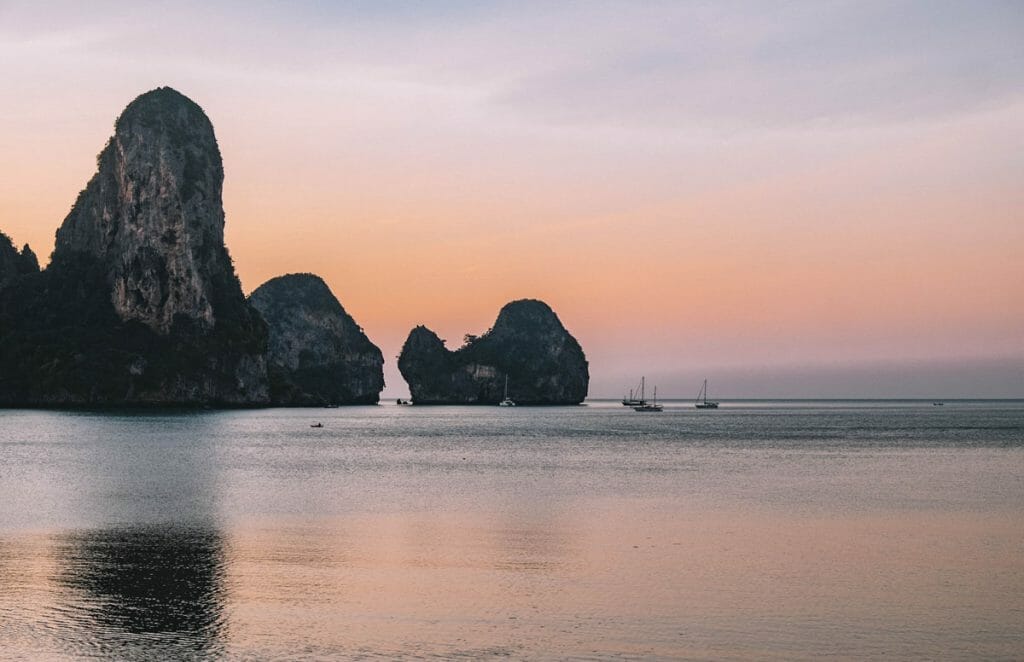
Sunset over the ocean in Krabi


What to Expect 

Tonsai Beach is one of Krabi's most stunning beaches. Plus, the area is ideally distant from all the noise pollution and nuisance common to adjacent beaches such as Ao Nang and Railay Beach and a site where climbers, backpackers, and tourists meet. Tonsai Beach, also spelled Ton Sai Beach, itself is truly calm and pleasant. Coming here, all first-time visitors will realize right away that Tonsai Beach is heaven on earth. Massive rock formations, tall palm trees, and the gorgeous sandy beach make Tonsai in Krabi to be particularly more rewarding that several visitors choose to prolong their stay.


7 Best Reasons for Visiting


1.  Affordable Accommodation

If you happen to be searching for a very nice accommodation around here, on Tonsai Beach, consider the charming Tinidee Hideaway, located in a fabulous spot with a breathtaking sight. Another very practical but nothing fancy is a stay at Basecamp dormitory room; it can't be booked online. 

2.  Enjoy a Fun Boat Ride

Reach Tonsai Beach is currently possible through a boat, and you can board any longtail boat that originates from a place like Ao Nang Beach; such a boat usually runs many times daily, and with maximum efficiency will get you to Tonsai Beach, rapidly.

3.  Take a Tour

While staying in Tonsai, you are recommended to go on a 4 Island Tour, which will allow you to explore the magnificent Koh Poda Island and Chicken Island.

4.  Great Food

You are recommended to dine at Mama Chicken. It's famous, the food is delicious, provides generous portions, and is perhaps the cheapest restaurant around.

5.  Excellent Tonsai Rock Climbing 

If you are new to climbing, you can take a course as well as rent equipment.

6.  Cave Exploration

There is a nearby cave that you can explore alone or with others. Just bring a flashlight.

7.  Less Populated

Unlike nearby beaches, Tonsai Beach is far less lively on account of there being less people. In fact, while here, you are certain to secure a peaceful spot under the shade of a palm tree.

In addition, you'll find a charming bay. Though the environment here is generally laid-back, the little bars grow somewhat busier during the night. Also, stop by the Tonsai Bay, the Tonsai pier, and Tonsai waterfall.


Most Famous Must-See Tourist Attractions in Thailand


Warorot Market (Kad Luang) -- A Popular Market in Chiang Mai

 Warorot Market, Chiang MaiColourful textiles at market


Warorot Market, or known locally as Kad Luang, ranks as one of Chiang Mai's top food markets, located in the heart of town. Warorot Market is in fact a historical landmark, where you'll see a fantastic and irresistible selection of speciality food ranging from fresh produce, ready-to-eat meals, snacks to genuine grilled northern-style side dishes like the spicy sausage sai oua, or the green and red chili dip called nam prik ong/nam prik noom that will please and satisfy nearly everyone still breathing. It won't disappoint. 

Also, Warorot Market offers cheap souvenirs, Arabica coffee to locally grown tea. Here's where it gets exciting: you can have fun bargaining the final cost of any product you want. You are advised to get some idea on how much common items cost beforehand so you can know how high or low anything costs.

Warorot Market exudes an old-school Chinese-Thai kind of feel to it. The whole facility is mostly old-looking which adds to its classical charm that attracts tourists from everywhere.

Warorot Market is comparable to London's Borough Market. Here, you'll see preserved meats as well as specialty snacks, plus the whole place is usually crowded with several tourists browsing around and sampling all sorts of tasty snacks.

Moreover, the market consists of two parts: Warorot Market and Ton Lamyai Market. Though both appear largely the same as well as inside, they are like two stores in one, with a road dividing them.

You can in addition shop for hours at the market's outer areas, where you'll find a wide range of many types of sellers and many street transactions happening all the time.

Warorot Market can be found as the Chang Moi Road ends, by the river. More precisely, located on 

Wichayanon Rd, Chang Moi, Mueang Chiang Mai, Chiang Mai 50300, Thailand. It's open daily from 4:00 AM to 6:00 PM.


Most Famous Must-See Tourist Attractions in Thailand


Haew Narok -- Breathtaking Waterfall in Khao Yai National Park

  Haew Narok WaterfallFile:Haew narok waterfall first tier.jpg


Is Haew Narok the Largest Waterfall in Khao Yai National Park?

Indeed. As Khao Yai's largest waterfall, it drops more than 150 meters from the height and into the basal lake. Haew Narok waterfall is actually one of Thailand's highest waterfalls. Visit during October and November, for this is when Haew Narok is most potent, and you may even hear its raw roaring power, as nature intended.  

Situated in Khao Yai National Park, Thailand. Haew Narok is more specifically in the park's south side and in the area belonging to Prachin Buri Province.

To commence, the trail that takes you there begins off at the nearest parking lot at 4325 feet in elevation. It's flat, wide, and paved. For around only 0.3 mile, you'll soon arrive at the wooden bridge and here you have to continue, crossing above the chocolate-brown gorge that finally will feed the waterfall.

Next part of this trail is somewhat ascending and broad for approximately 0.4 mile before reaching the last section. The trail's last section has quite a bit of steep stairs that descend below to the bottom of the waterfall for about 0.3 mile. But know that some of the steps do get so steep, challenging and might require clambering. The trail terminates at the overlook spot which happens to be the waterfall's highest point. While the altitude gain is around 700 feet, the trail stops at approximately 3625 feet.

If you prefer to observe the most comprehensive sight of Haew Narok waterfall, ask any ranger working at the ranger station, located at the trailhead, or parking lot, where they serve as a guide. A ranger will help navigate you to the part of the trail not well-maintained. Don't overlook the Hell's Fall while you're here.


Most Famous Must-See Tourist Attractions in Thailand


Prague's Charles Bridge -- Czech Republic's Greatest Tourist Attraction?

 Charles Bridge, Prague

Prague Bridge Night


Charles Bridge, in Prague, as a stone Gothic bridge, makes the significant connection between the Lesser Town and Old Town. In reality, Charles Bridge was known as the Stone Bridge throughout its initial many centuries. The Holy Roman Emperor and Czech king commissioned its construction, which started in 1357. Architect Petr Parler took charge of the bridge's construction. His other work was the St. Vitus Cathedral, part of the Prague Castle. It's believed that egg yolks got combined into the actual mortar to reinforce the bridge's construction!   


The Forerunner: Judith Bridge

Charles Bridge happens to be some of the monuments which were constructed during Charles' ruling period, but it isn't the first ever bridge connecting the Prague Vitava's banks. The other bridge which once stood there was the Judith Bridge, and first stone bridge across the river. That bridge was made in the year 1172 but in 1342 crumbled during a flood.

Unlike its obviously inferior forerunner, its replacement, Charles Bridge, proved superior, surviving several floods, and not too long ago in August 2002 the time the country underwent the worst possible flood in recorded history that includes the last 500 years. The addition of egg yolks must have worked. The Charles bridge length is 516 meters long.


Charles Bridge Towers

A tower stands on either end of Charles Bridge. Visitors could climb the Staroměstská věž, located on the Old Town side, and the Malostranská věž, located on the Malá Strana side to enjoy a fine vista of the bridge and Prague.


Baroque Statues

No less than 30 Baroque statues started to be added along both sides of Charles Bridge during the seventeen-century. Today several of them are only replicas but you can still see the originals in the Lapidarium. The prevailing 5-starred statue-attraction is perhaps St. John of Nepomuk, who was a Czech martyr saint executed in Wenceslas IV's reign via drowning after getting thrown from the bridge into the Vltava.  The statue's plaque has been repeatedly polished by numerous visitors having touched it throughout the centuries. Why? Because merely touching this statue in particular is thought to give good luck as well as increase the likelihood of a safe return to Prague.

Ranking high on tourists' to-do-list, Charles Bridge is also quite popular among Czech musicians, artists, and, of course, souvenir sellers whose stalls occupy each side of the famed bridge, year-round. A very good time to visit the bridge is particularly at sunset when you could then admire a stunning vista of the completely lit Prague Castle in front of the nightly sky.

As a pedestrian zone bridge, Charles Bridge today is nearly always swamped with people. If you wish to be the only one there, visit the bridge either at night or extremely early in the morning. Do not overlook the Charles Bridge Palace.


Most Famous Must-See Tourist Attractions in Czech Republic


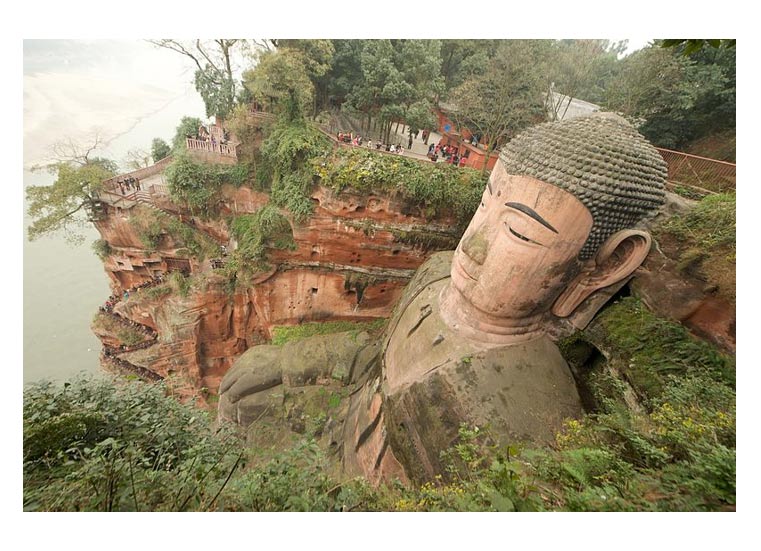
Leshan Giant Buddha -- No #1 Attraction Towers Majestically

The Leshan Giant Buddha Statue

Leshan Giant Buddha is the world's largest stone-carved Buddha

Leshan Giant Buddha Facts

Located in Leshan City, Sichuan Province, Leshan Giant Buddha was constructed during the 713 and 803 Ad time frame, rising 71 meters into the sky.

Leshan Giant Buddha in fact is a statue representing a Bodhisattva monk that's sitting. Leshan Giant Buddha lies more precisely to the eastern part of Leshan City, at the convergence of three rivers, respectively Min River, Dadu River, and Qingyi River. By standing so high and taking on a bigger-than-than-life status, the statue became the most famous tourist attraction in Leshan. In December of the year 1996, the entire area where the Leshan Giant Buddha sits was declared a UNESCO World Heritage-protected site. Started in 713 during the Tang Dynasty, completing by 803, Leshan Giant Buddha consumed nearly one whole century for people to carve. Throughout these years, workers in the thousands had poured both their tireless endeavors and wisdom into the on-going project. As the world's largest carved stone Buddha, Leshan Giant Buddha is now featured in story, song, and poetry.


The Size of Leshan Giant Buddha

By facing the river incidentally, the statue has a symmetrical outline and appearances exquisitely identified in its solemn serenity. Towering 71 meters tall, fingers 8.3-meter-long, and instep 9-meter-wide, Leshan Giant Buddha is large so that 100 people could sit on it. Moreover, the shoulder 24-meter-wide is big enough to accommodate an entire basketball playground.


Architectural Features about Leshan Giant Buddha

The allure of the statue exists not only because of its sheer physical dimensions but also on account of its architectural beauty. For example, there are literally 1,021 buns in its coiled hair, which have been carefully lodged in the head. And the overall effect of the painstaking labor is so stunning that the magnitude of buns appears inherent to the whole. 

Another architectural aspect worth noting is the sewerage system, which comprises concealed channels and gutters, distributed on the arms and head, back of the ears, and even in the clothes. This drainage system, which removes rainwater and thus maintains the inner section dry, fulfills a critical role in protecting the statue. Each ear, 7 meters long, is built of wood, plus mud adorns on the surface; it was no simple job to repair these for craftsmen from another much earlier era.
 

History of Leshan Giant Buddha 

A monk known as Hai Tong, began the project. But his main worry was for the greater safety of the hardworking people who habitually earned their honest living near the three rivers' confluence. Tumultuous waters guaranteed the accidents of boats were many and the uneducated people attributed natural disasters to a water spirit identity. As a solution, Hai Tong made up his mind to start carving a statue next to the river assuming that the now Leshan Giant Buddha would somehow quell the water spirit. Moreover, all the stones falling throughout the carving process would decrease the water's overall force there. With 20 years' worth of begging alms collected, he accumulated eventually enough funds for the project. When a few local governmental officials hinted their intentions to take his money, Hai Tong responded that they can remove his eyeballs but absolutely not all the money gathered for the statue. When Hai Tong did the unthinkable, digging out his own eyeball, the frightened officials fled. The project reached the point of being half done by the time Hai Tong died, and then two of his loyal disciples went on with the work. Following a grand total of ninety years' worth of labor, the project inevitably came to a completion.


Holding such a lengthy history and international renown, the Buddha's renovation has gotten much attention not only at home but also abroad. The Buddha was almost destroyed via the combined erosion of rain and wind prior to 1963, in which the Chinese government started major repairs. Currently, UNESCO experts have taken charge of the maintenance work.


Ways to Go from Chengdu to Visit Leshan Giant Buddha 

Train: take Chengdu-Leshan-Emeishan Intercity High-Speed Train from Chengdu to Leshan Railway Station; next, switch to bus 3 to get to this site.

Bus: it's 100 miles from Chengdu City to reach Leshan City if traveling by the expressway. Tourists could take a bus from Chengdu Xinnanmen Bus Station to reach Leshan Xiaoba Bus station, and finally switch to city bus 13 to get to this site.

Ship: numerous ferries travel to the Giant Buddha site daily. For example, Ferries to Chongqing, Yibin and Luzhou are available often at the city's port.

Air: Chengdu Shuangliu International Airport is approximately 93 miles away from Leshan by freeway. At the airport, you could board a train or a bus to reach Leshan downtown; next, switch to a city bus for arriving here.

Most Famous Must-See Attractions in China


Sedlec Ossuary's History -- Stuff of Darkest Nightmares?

Outside, it looks like this.


Sedlec Ossuary


The Sedlec Ossuary


The Sedlec Ossuary


Sedlec Ossuary, or referred alternately as the Bone Cathedral Sedlec Ossuary, happens to be an extremely unique chapel, the type where you might expect an infamous character like Freddy Krueger to live in!

If you suppose that you've seen everything already that's strange and bizarre, you are dead wrong!

Sedlec Ossuary though is ordinary-looking outside, it's the interior that will surprise you. Sedlec Ossuary is a rather little chapel situated in Sedlec, in Kutna Hora's suburbs, in the country of Czech Republic. From all physical appearances you would assume that the structure is only another run-of-the-mill ancient medieval Gothic church.

However, as you walk into the Sedlec Ossuary, you will immediately realize exactly why it is being regarded as the most astonishing church existing today in the world. Moreover, Sedlec Ossuary is adorned artistically with over forty thousand human remains (skeletons).

But perhaps the most intriguing artistic piece found inside Sedlec Ossuary chapel is the large chandelier of bones which hangs in the heart of this building. The massive chandelier holds no less than one of each human bone.

Yet another equally stunning work of art is the Schwarzenberg family's coat of arms which consists of human bones. Though there exist other worthy macabre sites to tour in Europe such as Paris Catacombs, nonetheless, Sedlec Ossuary stands out as truly distinct in its own right.

You might be wondering to yourself how on earth did all these bones get stuck in a little church. Well, it all goes way, way back to the year 1278 when a Bohemia's king ordered the abbot, residing in Sedlec Cistercian Monastery, to travel to Jerusalem.

After the abbot returned, he carried on him a container of soil that originated from the Golgotha, which was called the “Holy Soil.” Quite fast, and because people from everywhere wanted to be buried predictably in Sedlec, the cemetery nearby had to be elongated to meet the demand.

During the 15th century a new structure rose: a Gothic church which was built close to the cemetery, plus its basement getting used as a sort of crypt. These bones remained there for century after century until 1870; a woodcarver, Frantisek Rint, came around, got appointed to put these bones in some kind of order. Thus, the result was spectacularly astounding.

If you wish to see this unusual marvel, you could visit Prague, the Czech Republic's capital, and then there you'll take any transport, car or bus, equaling about 1 hour drive to Kutna Hora.

Although Sedlec Ossuary might appear a rather macabre place, you'll discover that it's not frightening at all but surprisingly tranquil instead.

All those forty-thousand corpses desired once to have their remains resting in a sacred site, that is precisely why they came to Sedlec, and today their bones lay smack in the heart of the chapel.


Most Famous Must-See Attractions in Czech Republic


12 Must-Know Guggenheim Museum Facts

  Guggenheim Museum, Bilbao Guggenheim Museum at a Glance Guggenheim Museum has proven to be the most significant structure of Wright's ...