8 Top Must-Know Facts About Hofburg Imperial Palace


picture


Hofburg Imperial Palace

Situated in the heart of Vienna, Hofburg Imperial Palace was constructed in the 13th century. It functioned as the winter residence for the rulers, while Schonbrunn Palace served as the summer residence. Here's my list of 8 top must-know facts about the Hofburg Imperial Palace.

1.  Home to some of Europe's most powerful individuals

The Habsburg Empire proved to be extremely strong and the broadest ruling in Europe because of a number of key factors such as strategic marriages and warfare. The Habsburgs succeeded in amassing a vast fiefdom prior to the dynasty finally falling in 1918.

2.  The Hofburg resembles a city rather than just a palace. 

There are, for example, 18 different wings in the palace, and each designed by a different renowned architect. One minute you are admiring Baroque splendor, then another minute you might be surprised by the neo-classical severity. But one fact is certainly constant: everything you see is on a magnificent scale.

3.  Wing after wing

Everyone knows what it's like when moving into a new residence -- you have the itch to make changes. Well, the Habsburgs did that for over six centuries! Consequently, the Hofburg Palace became a collection of buildings, home to many wings, halls, libraries, and squares.

4.  Heart and soul

Since the Habsburgs ruled for a very long time, many rulers, about 150 bodies of emperors and empresses have found their final resting place in the Capuchin Crypt; their hearts are symbolically bound to the Augustinian Church, and their remains lie in the crypt under St. Stephen's Cathedral. 

5.  Some sections go as far back to the 13th century.

The oldest parts of the Habsburgs Imperial Palace date back to the 13th century and are found in the Swiss Wing.

6.  The palace is home to the Austrian President

Currently, the president of Austria calls the palace his official residence. 

7.  The palace is probably the largest in the world

With more than 2,000 different rooms, the Hofburg Imperial Palace is most likely the largest existing palace in the whole world. 

8.  The palace's largest room

The Festival Hall, serving as a throne room, is the biggest room, but never used as such.

It may take anywhere between 3 to 4 hours to tour through the entire palace. Consider visiting the nearby Sissi Museum as well.




7 Top Must-Know Facts on Temple of Artemis at Ephesus

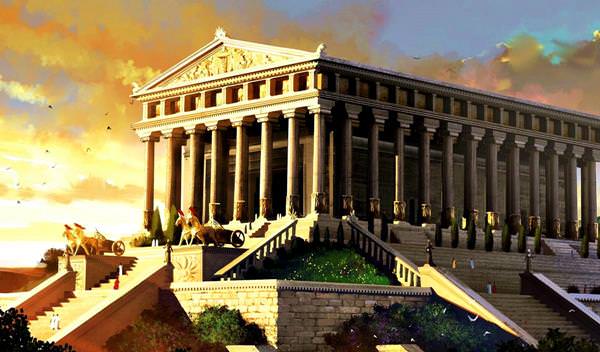
Temple of Artemis at Ephesus

Temple of Artemis at Ephesus, Turkey


Situated in Ephesus, Temple of Artemis was one of the ancient world's most beautiful temples. Ephesus was a very old Greek city which lies in what's today southwest Turkey's Selcuk.


The temple itself was built in dedication to the goddess Artemis, connected with the Roman Diana goddess, which in turn explains why the temple is sometimes called the Temple of Diana.

Moreover, the temple is now regarded quite highly as one of the ancient world's 7 wonders. Keep reading and you'll learn much more through my list of 7 top facts on the Temple of Artemis at Ephesus.


1.  Why was so significant about the Goddess Artemis?

Not only was Artemis a Greek goddess but also Zeus's granddaughter and Apollo's twin sister. She was specifically the goddess of the wilderness, untamed animals, the hunt, chastity, the moon, and the Roman version was her equivalent.

In addition, Artemis was a very honored goddess in ancient Greece; the stunning temple which was constructed for her proves how honored she was.

2.  A flood destroyed the temple

The temple's initial version was actually a peripteral temple, and perhaps the first one of its types to be made in Greece. 

But a flood destroyed the temple in 7th century BC, leaving it in ruins for a period lasting about 150 years.

3.  The 2nd temple was built much larger

The reconstruction of the temple began in 550 BC and was completed within 10 years. It was really the first Greek temple to be erected using marble.

However, the Temple of Artemis's second version was far grander than the first. The columns stood thirteen meters tall in double rows, 36 of them adorned with reliefs venerating the gods. 

It was as large as a soccer field; 115 meters in length and 46 meters wide, approximately 4 times larger than the first one.

4.  Then a fire destroyed the temple

Some have described the Temple of Artemis as being the most beautiful building seen by human eyes; that is indeed high praise for a structure.

But one man known by the name of Herostratus believing he would achieve eternal fame by destroying the temple, actually lit the wooden roof on fire. He did get his fame but the negative version instead.

He was not only tortured but also executed. Moreover, as a measure to guarantee that he would not succeed in achieving glory, anyone who just mentions his name would suffer the same fate.

5.  The last version was self-funded 

Although Alexander the Great wanted to fund the temple's reconstruction, Ephesians refused. He and his supporters self-funded the last version and construction began in 323 BC.

The temple's final version was even larger than the last one, being 137 meters in length by 69 meters wide and 18 meters tall. Plus, it had over 127 columns.

6.  It was expected to be far more stunning of the seven wonders

Antipater of Sidon, a Greek poet from ancient times, who lived in the 2nd century BC, happened to be among the first ones to create a list of the world's wonders. He was obviously so blown away with what he beheld. 

7. The Temple of Artemis' final destruction

One source, a historian by the name of "Jordanes," said a Germanic tribe lit it on fire and thus destroyed it in 268 BC.

What precisely occurred next is unknown. But whatever remnants were left from the temple were used as building materials for building other structures. For example, some of the surviving columns were used when constructing Hagia Sophia in Turkey.  


Most Famous Must-See Tourist Attractions in Turkey


7 Top Unpleasant Facts About Lenin's Mausoleum

 Lenin's Mausoleum


One of Moscow's most fascinating landmarks is the extraordinary mausoleum belonging to one of Russia's great leaders.

In this blog post, you'll discover unusually interesting facts on Lenin's Mausoleum, the intriguing but still eerie final resting site of famed Russian leader Vladimir Lenin. 

I kept the last fact for last, since it's the best one revealing the secret to Lenin's unbelievable rosy skin complexion!

1.  It's situated on Moscow's most famous square

Out of all the outstanding buildings lining Red Square, Lenin's Mausoleum is unquestionably the most uncommon, bordering on strange.

It's actually an unappealing monument shaped as a step-pyramid, standing before the East Kremlin Wall. It now serves the function as Russian leader Vladimir Lenin's final place of rest, who died in 1924. 

2. Two days after Lenin's death a wooden tomb was built

Following his death, a wooden tomb was built so the citizens of Moscow can see his body.

A  famous Russian architect Alexey Shchusev designed the wooden structure and only days after his demise, on January 27, Russians were forming a line in order to look at their leader's lifeless body.

But by August and in the same year, a much bigger structure replaced the wooden one, and then Lenin's body was transferred into a sarcophagus that was placed on public display.

3. Since 1924 Lenin's body has been publicly displayed

Probably the most stunning fact about Lenin's Mausoleum, the one that rivals even those of the best Egyptian mummies, is that his human remains have been displayed publicly inside this building from the time he was initially put here shortly after his death. 

The sarcophagus that stores his body is built of glass, allowing visitors to clearly see his whole embalmed body just lying here as if only sleeping and about to wake up at any moment! Can that be said about any mummified remains?

During the time period from 1941 to the ending of WW ll, Lenin's body was moved briefly to Siberia to prevent it from getting taken by the Nazi army that invaded. Then, in 1973 a new sarcophagus replaced the old one.

There was a new plan of moving Lenin's body into a brand-new structure that would serve like Russia's version of Pantheon, of course, modeled on Rome's Pantheon, but finally was shelved.

4. The current structure was modeled on a step-pyramid

The structure's design, a step-pyramid, was no accident. Since time was of the essence, the structure was modeled on a funerary monument, more specifically, that of Step-Pyramid of Djoser, which is one of Egypt's most ancient as well as most intriguing attractions.

5.  Another mummy joined Lenin's after World War ll

Joseph Stalin's embalmed body, once ruling the Soviet Union, joined Lenin's body between the years 1953 and 1961.

The 1960s was an era of de-Stalinization and a period known as the "Khrushchev's Thaw," for this was when the repressive grip of the former regime was loosened, beginning immediately after Stalin's demise; this finally culminated in his remains getting transferred from Lenin's Mausoleum.

Stalin's body was inevitably buried inside the Kremlin Wall Necropolis, standing behind the mausoleum.

6. The mausoleum's designated guard of honor was transferred to another tomb

The guard of honor in Russia is called the "Number One Sentry" who ceremonially protects the mausoleum from the time the order was issued back in 1984. This guard was finally disbanded, following the constitutional crisis of Russia in 1993.

However, in 1997, this type of guard officially went back in effect, except this time it had the role to protect the tombstone of an unnamed soldier, which represented a war memorial in dedication to all the soldiers dying in WWll, lying in the Alexander Garden.   

Every guard has the duty lasting for one hour before another ceremony occurs when a new guard takes his place.

7.  Maintaining the corpse in excellent condition is no simple job

How do you manage to keep anyone's body from decomposing completely, and far more challenging, appearing exactly the same as it once did right after the person dies?

After Lenin's body was placed on display for all eyes to see, it required specialized maintenance by a group of embalmers. In order to preserve Lenin's face and hands from showing dark spots, this team had to use ethyl alcohol and acetic acid.  

Additional maintenance was required through hydrogen peroxide for restoring the skin's authentic color. A mix of phenol or quinine, potent disinfectants, are getting used for wiping out damp spots.

The outcome is honestly stunning as it seems that he just died yesterday, although it's nearly 100 years ago.

By the way, it's free to visit Lenin's Mausoleum.


Most Famous Must-See Tourist Attractions in Russia


5 Top Must-Know Tips Before Visiting Langkawi Sky Bridge

 File:Langkawi sky bridge.jpg


This post will properly arm you with necessary information before going to the bridge in order to have the best possible experience. 

If you have not gone there yet but are considering the adventure, you'll learn exactly why Sky Bridge, a Langkawi's iconic landmark should rank high in your must-do list.

Constructed by linking two hilltops from Mount MatCincang, the Langkawi Sky Bridge is a curved suspension bridge situated at the top of the breathtaking hills. It's the perfect view that Langkawi offers, but definitely not for everyone.  

Extending for nearly 125 meters and hanging at least about 100 meters over the ground, strolling along the Sky Bridge is more than only sight-seeing. You'll get the opportunity to observe the landscape from perspectives that tend to vary at different points of where you happen to stand on the curved bridge. 

On account of its height and its curved structure, constructing Sky Bridge was no simple feat. Moreover, it's now regarded as one of the world's engineering wonders. Many factors were considered that range from the ideal load, the balance to all the details involved in the fabrication process.


5 top tips before visiting the Sky Bridge


1. What's the best time to visit the Sky Bridge?  

Early morning, if wishing to beat the queue. Also, tourists could visit about the late afternoon for another chance when it's less crowded.

2. How can I avoid paying additional charges?  

While lining up for the Sky Cab, visitors automatically will be photographed and their photographs printed without seeking permission. Of course, many visitors have complained about feeling forced to pay for such unasked photos. So, to avoid altogether this extra but needless charge, politely refuse when they attempt to pull you aside to the screen to take your photograph. There's no guarantee it'll work, but it does work for some.

3. Short nature stroll or Sky Glide to Sky Bridge?  

Sky Glide is perhaps the best alternative. The brief nature walk may be more physically demanding for some visitors; it can get quite steep and the entire trip is tiring.

4. What are the most suitable clothes for Sky Bridge?  

This will depend on the current weather; since it can get rather cold and windy up there, wearing a cozy jacket may be appropriate.

5. What essential items to take to Sky Bridge.  

Bring your sunscreen, hat, and sunglasses. Up at those heights, you will be exposed more directly to sunlight. So, do not forget the sun protection that you'll need. Since shops on the Sky Bridge sell snacks, you do not have to carry food on you.


5 Best-Rated Must-See Tourist Attractions in Malaysia


Batu Bolong Beach -- Surfing, Swimming, Kite Surfing, Rafting + Attractions

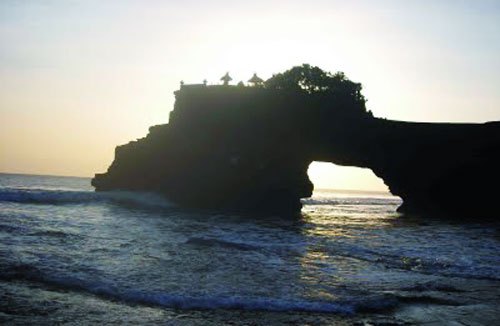
Batu Bolong Beach


In addition to sunbathing, swimming, and surfing, consider strolling along the coast side and admiring the natural wonders and landscape that Batu Bolong Beach offers. Located in Canggu, Bali, this is the ideal destination for all beach fans and sun lovers. Here, you can kite surf and try Bali white water rafting as well.

Because the waves of Batu Bolong Beach are slower and easier to get, it's a favorite place for novices to learn how to surf. You can rent surf boards.

Later, you can walk to the enchanting Batu Bolong Temple or Pura Batu Bolong, standing just over the beach on its cliff. If you believe observing the sunset from the beach is stunning, try watching the intoxicating sunset from one of its temples; it's a highly recommended place.

After you've walked around and seen the most significant attractions, take a break while enjoying Indonesian food and drinks. Several hawkers close by offer all types of sweets that you could buy cheaply. 

What to do close by

There are many other beaches not far. Here are some worthy suggestions to choose while visiting Canggu, Bali. 

  • Echo Beach.  Only 300 meters away, you could experience another tropical paradise beach. Echo Beach is renowned for its swimming and surfing with its wonderful reef breaks. Tourists taking a morning walk along this area, could also choose to view the sunset. During your visit, sample their barbecue seafood dishes, which you're guaranteed to love.
  • Canggu Beach.  Around a 14-minute stroll away lies the better known Canggu Beach, famous for its superb surfing spot. This beach provides not only amazing waves for the more advanced surfers but also surfing schools to help beginners to learn how to surf. In addition, there are fine cafes, perfect for lounging and sipping a pleasant cold drink with a nice beach-front vista. You can also find decent accommodation while in this general area, for there are several luxury resorts close by.


Most Famous Must-See Tourist Attractions in Indonesia


Batu Secret Zoo -- Type of Amazing Animals, Facts, Rules, Family-Friendly

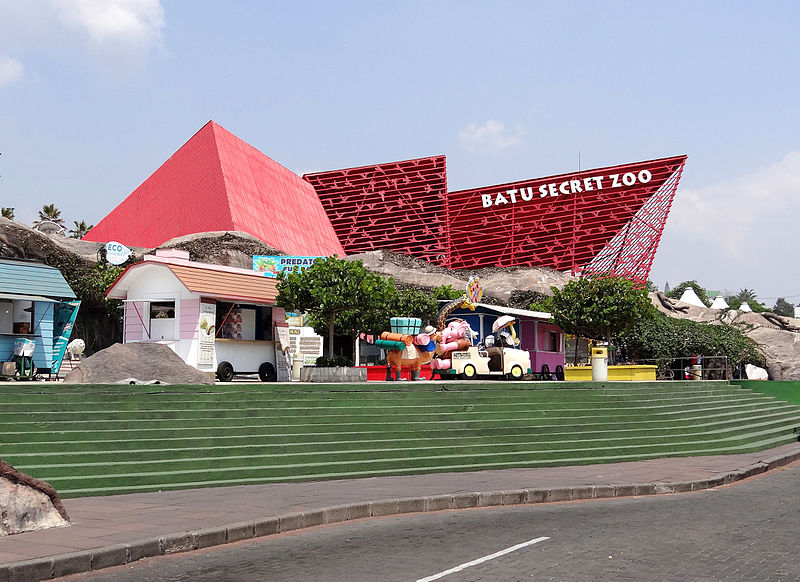
File:Batu Secret Zoo entrance pavilion.jpg 


If you thought Museum Satwa's replicas and specimens were awesome, you've seen nothing yet until you've visited Batu Secret Zoo! Here, you'll enjoy the genuine ones. Batu Secret Zoo will deliver an experience that will satisfy you in more than one way.

Located in Batu, East Java, Batu Secret Zoo comprises an area totaling 14 hectares. It opened in 2001. It's a great place for the whole family and all staff and workers are super friendly. It's more of a modern zoo displaying animals native to Indonesia as well as foreign imported animals.

When you come in through the gate, antiseptic is sprayed on you in order to protect its animals from any potential viruses visitors may be carrying. Then, your trip starts with different types of flying lemurs.

Next, you'll spend some time observing unusual species locked inside metal and glass cages, fences, or aquariums where you'll be amazed. It might seem impossible for anyone just to skip or look at each species with a rapid scan. But if you happen to grow tired at any point in the heart of the zoo, know that visitors could always use an e-bike to cruise along the tracks. Also, you could take fantastic pictures with exotic animals. Employees can even assist you by managing your camera as you pose with any number of likeable animals such as a baby lion or a large albino tiger, if you're daring enough.

You'll find varying kinds of species originating from different parts of the world but Antarctica in this zoo. For example, a hippo doing its usual swimming routine inside an aquarium-looking cage, huge turtles, ostrich, apes, foxes, bears, bulls, emu, elephants, mountain goats, flamingos, giraffes, and much more carrying on in their artificial but comfortable habitats. 

You could even go so far as to tease them by mimicking their sounds, however, you're not permitted to feed them. The exception is Kalongs, a type of large bat. Before its cage there is its favorite food--bananas--which you could grab a piece of with a toothpick and begin feeding them as they hang about.

5 Top-Rated Must-See Tourist Attractions in Indonesia


7 Most Fascinating Facts About Fushimi Inari Taisha

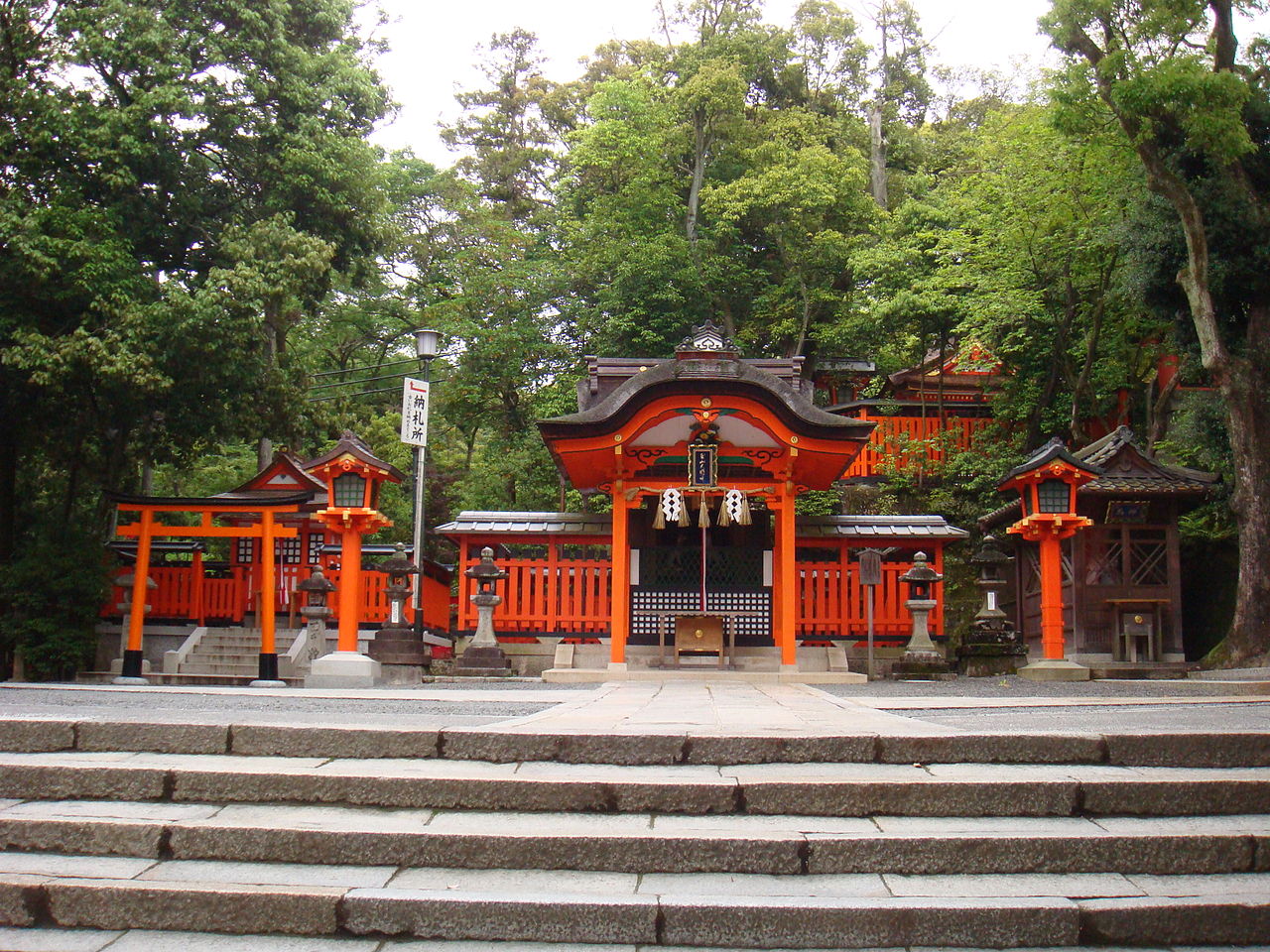
 Fushimi Inari Taisha

Fushimi shrine entrance


Fushimi Inari Taisha is a very significant Shinto shrine in Kyoto, Japan, and numerous tourists visit it because of its stunning orange gates which they find so inviting.

Located in southern Kyoto at the bottom of Mount Inari, the shrine was dedicated to Fushimi Inari Taisha, the patron of merchants and god of prosperity and rice.  

In order to get to this shrine, you'll have to climb up the mountain that rises 764 feet beyond sea level. Bear in mind that other shrines exist scattered along the trail that extends for around 2.5 miles.

Gain more understanding by reading the most fascinating facts about this sacred shrine.


1.  Fushimi Inari now Japan's oldest Shinto shrine 

Fushimi Inari Taisha, built in 711, is today one of Japan's oldest shrines in all of Kyoto. In fact, by 942, the shrine ranked unusually high among Shinto shrines. Later, the lovely and decorative major shrine building was erected in 1499.

Legend has it that the locals held the belief that a rice cake was tossed into the air, transforming into a swan like magic. The swan next soared to Mount Inari's peak. Quite soon, rice began growing upon the mountain, becoming the main shrine for Inari Okami.

2. It's one of Japan's most visited attractions

Literally millions of visitors from everywhere go here to pray for successful business, improved harvests, and more. But far more people flock here in the New Year to offer their prayers. Others come to admire the shrines as well as stroll through the mountain trails.

Toyotomi Hideyoshi donated in 1589 the Romon Gate, one of the oldest ones, situated in the rear of the shrine's central hall, where guests pay homage and even provide small offerings.

3. It has many small shrines

The complex, which has several smaller sub-shrines scattered along the four kilometer trail around the mountain, consists of 5 main shrines, upper, middle, lower, and 2 auxiliary shrines. But the most holy among them is Mount Inari, regarded as the god of rice.

To reach the top, you must pass through 1000s of Torii gates, situated behind Fushimi Inari, and it's precisely here you'll come across the hiking trail that takes you up the mountain.

4. The shrine was moved

Originally standing on Inariyama hill in Kyoto, the Hata family relocated Fushimi Inari Taisha elsewhere permanently in 816.

There was even a change of guard occurring back in 942, when it received the highest honor among Shinto shrines.

Many centuries passed until in 1499 the lovely and central shrine structure was erected. More recently, Japan designated the shrine as a significant Cultural Property. 

You'll observe thousands of mounds on the mountaintop being used for worship in private.

5. There are many fox statues

The twelve fox statues surrounding the shrine is a conspicuous feature that's impossible to miss. Japanese consider the foxes gods' messengers as well as connected with the rice god.

Moreover, the fox statues hold keys in their mouths, which symbolize that they are the defenders of rice granaries. That's why foxes are not only well respected but also worshiped.

6. The Torii are very popular attractions

In the rear of the shrine's central grounds you'll find the Senbon Torii, which serves as the entry to the Torii gate. In addition, it marks the start of two parallel, thick rows of gates, which attract the majority of tourists to visit Fushimi Inari Taisha. 

As a traditional gate in Japan, Senbon Torii is generally located at the entry of or just within a Shinto shrine. It actually represents the transition from the everyday profane to the holy. 

Every one of the renowned gates is also a handsome donation via either a private citizen or Japanese business individual. They are motivated to donate hoping to receive future fortune and good luck.

The orange and reddish color of all such gates symbolizes the sun.

7. Reaching the shrine is no small feat!

Climbing to the mountaintop is rather an uphill challenge. If you're not physically inclined, slowly climb here at a comfortable rate. Although the trail is lengthy and goes on rising, fortunately there exist platforms where you can halt by and take a quick break. The hike to Mount Inari can take up to 60 minutes. But the view from the top is quite beautiful. You'll find some cafes which serve dishes like Inari Sushi.

Most Famous Must-See Tourist Attractions in Japan


12 Must-Know Guggenheim Museum Facts

  Guggenheim Museum, Bilbao Guggenheim Museum at a Glance Guggenheim Museum has proven to be the most significant structure of Wright's ...